
About Us

What is GRIHA?

GRIHA (Green Rating for Integrated Habitat Assessment) is India’s national rating system for green buildings, developed by TERI (The Energy and Resources Institute) and adopted by the Government of India in 2007. GRIHA is a rating tool that helps people assess the performance of their building against certain nationally acceptable benchmarks.

Why GRIHA?

GRIHA, India’s indigenous green building rating system, is recognized in the country’s climate commitments to the UNFCCC (United Nations Framework Convention on Climate Change) for its role in carbon mitigation. It forms a key part of India’s strategy to reduce GHG emissions through sustainable habitat development.

GRIHA Council

GRIHA Council is an autonomous, not for profit society established to promote and administer the development of sustainable buildings and habitats in India through the GRIHA rating.

Our Approach

GRIHA attempts to minimize a building's resource consumption, waste generation, and overall ecological impact to within certain nationally acceptable limits / benchmarks. Going by the old adage 'what gets measured, gets managed', GRIHA quantifies aspects such as energy consumption, waste generation, and renewable energy adoption.

Our Vision

We, at GRIHA Council, stand for credibility, integrity and inclusiveness, while upholding Indian ethos for future-ready and sustainable habitat.

Evolution of GRIHA

The rapid increase in Indian population and growth of Gross Domestic Product (GDP) has given rise to an enormous demand for buildings with a subsequent pressure on availability of resources. Another key challenge for the built-environment of Indian cities is the diminishing availability of water for urban areas. In order to be sustainable, the environmental pressures of increased demand for resources coupled with a rapidly changing climate are being addressed by policy makers at various levels. Several policy and regulatory mechanisms to address the urban challenges, implemented through national plans and programmes have been devised. TERI has played a crucial role in convergence of various initiatives, essential for effective implementation and mainstreaming of sustainable habitats in India. With over two decades of experience on green and energy efficient buildings, TERI has developed GRIHA, which was adopted as the national rating system for green buildings by the Government of India in 2007.

2007
National Rating System Adopted
20+
Years of Experience
100%
Indian Standards

GRIHA Impact

With over 3,900 registered projects encompassing 930 million square feet of built-up space, GRIHA has delivered a quantifiable environmental impact. Rated buildings have saved over 2.6 million MWh/annum in energy consumption and offset more than 7,40,000 tonnes of carbon dioxide emissions annually.
10
Registered Project
5
Rated Project
27
Policies

GRIHA Life Cycle Assessment Stages

Pre-construction Stage

Intra- and inter-site issues like proximity to public transport, type of soil, location, flora and fauna before construction, natural landscape and land features.

Building Planning & Construction

Resource conservation and reduction in demand, utilization efficiency, resource recovery and reuse, provisions for occupant health. Prime resources: land, water, energy, air, and green cover.

Building Operation & Maintenance

Operation and maintenance of building systems, monitoring energy consumption, occupant health and well-being, and issues affecting global and local environment.
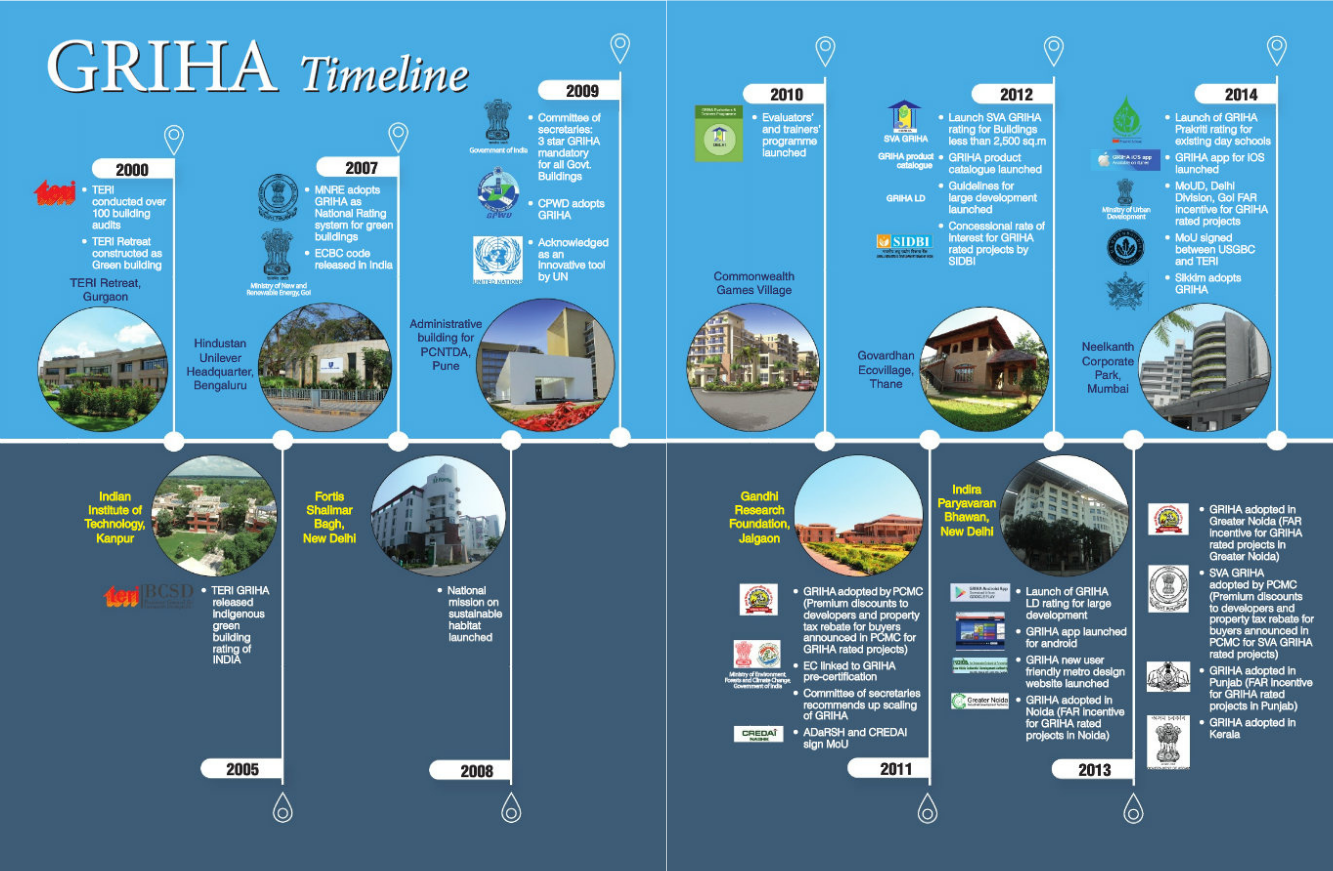
genesis of GRIHA Image

Figure 1: Evolving landscape of sustainable habitats in India: genesis of GRIHA

Benefits of Green Building

Energy Efficiency

Reduced energy consumption without sacrificing comfort levels.

Environmental Protection

Reduced destruction of natural areas, habitats, and biodiversity.

Pollution Reduction

Reduced air and water pollution with direct health benefits.

Water Conservation

Reduced water consumption through efficient systems.

Waste Management

Limited waste generation due to recycling and reuse.

Reduced Pollution

Minimized pollution loads on the environment.

User Productivity

Increased productivity through healthier environment.

Cost Savings

Long-term operational cost reduction through efficiency