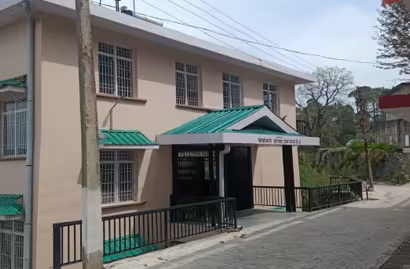
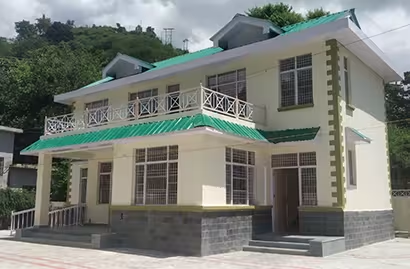
Construction of Treasury Building at Kuthar
SVAGRIHA Rating:
The SVAGRIHA rating system was developed to promote green buildings which are smaller in size with built-up area less than 2500 sqm, thus require a dedicated rating as suitable to Indian climate zones. It was conceived with idea to create a rating for all kind of building typologies which incorporate the measures of green buildings as feasible to the project.
SVAGRIHA, an abbreviation for Simple Versatile Affordable GRIHA, was conceived to spread out the concept of green buildings and sustainability to small-scale stakeholders, that is, owners of projects such as bungalows and small offices. It was developed as a simple guidance-cum-rating tool to ramp up its adoption by general masses and minimize the GHG emissions caused by small-scale constructions.
The system acknowledges the requirement of rating tool for small projects thus integrating features applicable to smaller projects. The rating system will also help the project team to understand the qualitative and/or quantitative impact of their project on the environment.
The Good Life Goals (GLGs) were rolled out by the United Nations to encourage, individuals to participate in improving the health of our planet and live in harmony with the nature and other beings. The GLGs aim at the larger goal of achieving the 17 Sustainable Development Goals (SDGs). ‘The SDGs, also known as the Global Goals, were adopted by the United Nations in 2015 as a universal call to action to end poverty, protect the planet, and ensure that by 2030 all people enjoy peace and prosperity’ (UNDP 2021). SVAGRIHA targets to achieve a few of the GLGs by adopting the design guidelines specified in various sections of the rating system.
SVAGRIHA has been formulated in accordance with the various national and international standards, codes and policies like BEE Standards & Labelling Programme, Energy Conservation Building Code (ECBC) and Eco-Niwas Samhita (ECBC-R), ASHRAE 62.1-2019 and National Building Code.

It aims at creating user satisfaction through optimized design solutions.
This aims at ensuring improved thermal, visual, and acoustic performance of the building along with better indoor air quality (IAQ).
With minimum requirements for extensive documentation, the rating is suitable for smaller projects with limited dependency on all the stakeholders of the project.
With small projects being limited to a smaller segment, the rating enhances the visibility of the project in the market.
| Points | SVAGRIHA Rating |
|---|---|
| 25-29 | ⭐ |
| 30-34 | ⭐⭐ |
| 35-39 | ⭐⭐⭐ |
| 40-44 | ⭐⭐⭐⭐ |
| 45-50 | ⭐⭐⭐⭐⭐ |
The fast-track process is intended to provide handholding support to projects that need a faster clearance for various business and government approvals. It reduces the time required for rating while maintaining the integrity and accuracy of the SVAGRIHA rating system.
| REVIEW STAGE | REVIEW PROCESS | FAST TRACK |
|---|---|---|
| Review of 1st Submission | Within 20-25 working days | Within 5-7 working days |
| Final Site Visit | Done within 20-30 days after sending review comments | Will be done within 5-7 working days after sending the review |
| Due Diligence report | Sent within 15 working days after site visit | Will be sent within 2 working days after site visit |
| Final Review | Done within 8-10 working days after receipt of 2nd documentation | Will be done within 3-5 working days after receipt of 2nd documentation |
Fast Track Fees: Rs. 2 lakhs+ Taxes Applicable as per the Government norms.
| Sections | Criterion Number | Criterion Name | Criterion Brief | Maximum Points of the Criterion | Maximum Points of the Section | Minimum Points to be Achieved in the Section |
|---|---|---|---|---|---|---|
| Sustainable Site Planning | 1 | Site Planning | Planning layout for optimal land use. | 5 | 12 | 6 |
| 2 | Passive Design Strategies | Strategies for natural ventilation and daylight | 3 | |||
| 3 | Efficient Envelope Design | Energy-efficient building envelope design | 4 | |||
| Low Environmental Impact Materials | 4 | Low Environmental Impact Materials in Structure | Eco-friendly materials for structural elements | 2 | 7 | 4 |
| 5 | Low Environmental Impact Materials in Walling | Sustainable materials for wall construction | 2 | |||
| 6 | Low Environmental Impact Materials in Fenestrations & Interiors | Green materials for windows, doors, and interiors | 3 | |||
| Energy Optimization | 7 | Optimizing Energy Consumption | Reducing energy demand through efficient systems | 5 | 8 | 4 |
| 8 | Renewable Energy Utilization | Use of renewable energy sources | 3 | |||
| Occupant Comfort and Well-being | 9 | Indoor Air Quality & Comfort | Ensuring good indoor air quality and occupant comfort | 7 | 7 | 4 |
| Water Management | 10 | Reduction in Building & Landscape Water Demand | Lowering building and landscape water usage | 5 | 8 | 4 |
| 11 | Rainwater Management | Collection and reuse of rainwater | 3 | |||
| Solid Waste Management | 12 | Solid Waste Management | Waste reduction, segregation, and recycling practices | 3 | 3 | 1 |
| Sustainable Lifestyle | 13 | Adoption of Sustainable Lifestyle | Promoting eco-conscious habits among occupants | 5 | 5 | 2 |
| Innovation | 14 | Innovation | Introducing novel sustainable practices or ideas | 2 | 2 | - |
| Grand Total | 50 + 2 | 50 + 2 | 25 | |||
Maximum and Minimum points: There are points in each criterion which can be achieved maximum upon complying with all appraisals under the criterion. The maximum points that can be achieved in the rating are 52 upon inclusion of 2 points of bonus points. Further, there are minimum points which are required to be achieved under each section for each achieving the final rating. The minimum points required for achieving the rating are 25 points.
SVAGRIHA:
The fee for rating system is Rs 20,000 + Rs 50 per square meter (exclusive of GST)
Additional cost (if opted):